> ## Documentation Index
> Fetch the complete documentation index at: https://docs.penbox.io/llms.txt
> Use this file to discover all available pages before exploring further.
# Document Intelligence models
> Choose between the Fast and Advanced extraction models
Document Intelligence 3 introduces two extraction models instead of one, so you can match the level of extraction to the difficulty of the document rather than paying the same rate for every page.
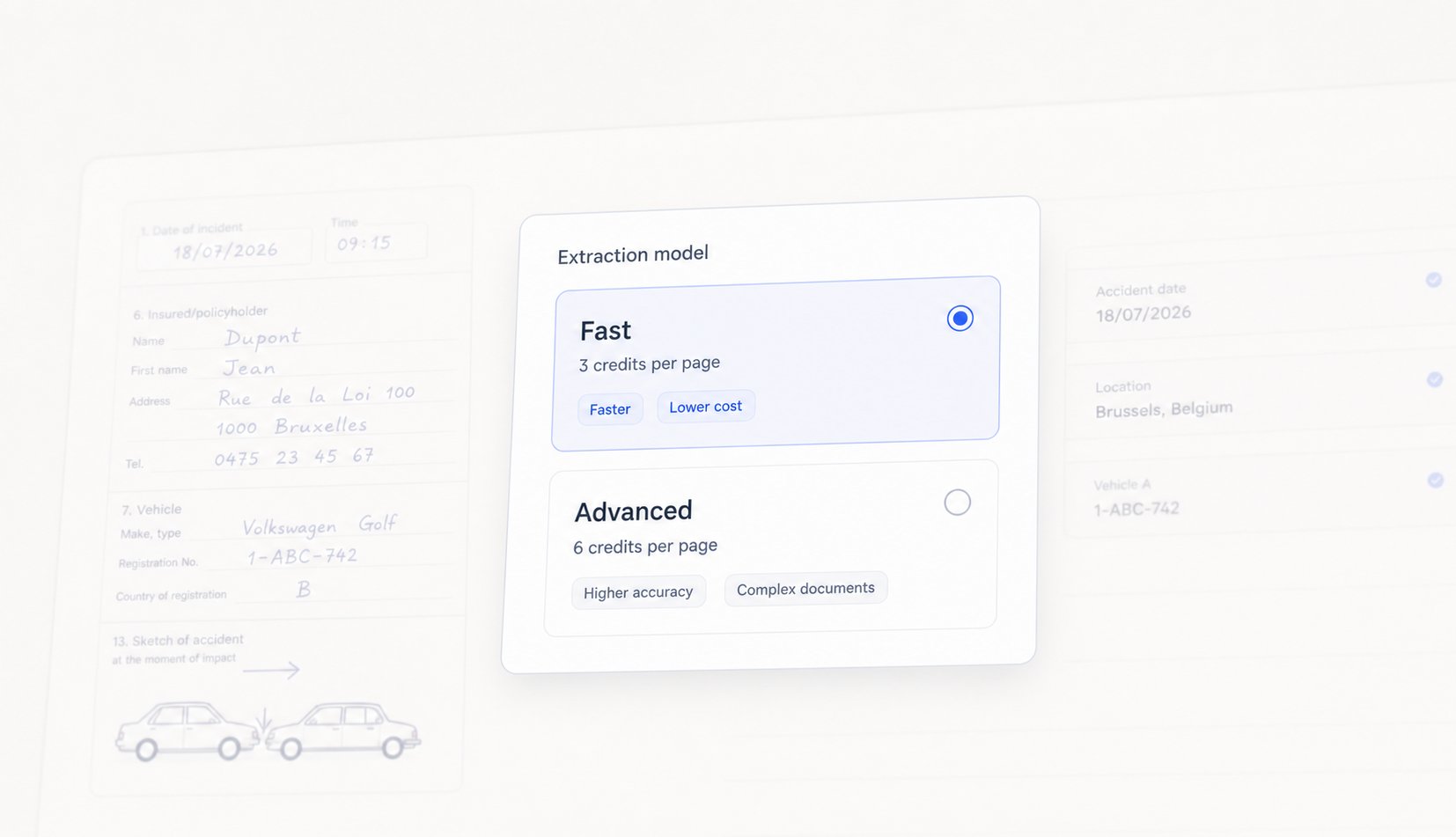 Models apply to [Document Intelligence templates](/guides/document-intelligence-first-template). The model you pick changes how a document is read, not what is extracted: your fields, types, and hints stay exactly as you configured them.
## What changed in Document Intelligence 3
* **Fast** replaces the previous extraction model on every existing document type, at the same rate of 3 credits per page. It is 30% faster and 25% more accurate than the model it replaces.
* **Advanced** is new, at 6 credits per page. It is 50% more accurate and reasons over the whole document instead of reading it field by field.
The Fast upgrade applies automatically. There is nothing to reconfigure and nothing changes in your credit usage.
## Fast
Fast is the default model and covers the documents most workspaces process every day: ID cards, bank details, invoices, policy schedules, certificates, and other structured or printed documents where the values sit in predictable places.
At 3 credits per page it is the cheapest model, and it is now also the quickest: a page comes back 30% faster than before, with fewer values needing a manual correction afterwards.
## Advanced
Advanced is built for documents Fast has to guess at. Instead of locating each field independently, it reads the document as a whole and reasons across it, which is what messy handwriting, checkbox grids, and multi page context require.
Use it on:
* **European accident statements (constat amiable).** Handwritten boxes, free text, and the collision sketch have to be read together to produce a coherent result.
* **Complex handwritten documents.** Medical certificates, filled-in paper forms, annotated contracts.
* **Documents that need inference.** Cases where a field is not written anywhere as such and has to be derived from the rest of the document.
Advanced runs only 10% slower than the new Fast model, which still makes it faster than the model it replaces.
## Choosing between the two
| | Fast | Advanced |
| -------------------------- | -------------------------------- | ---------------------------------------- |
| Cost | 3 credits per page | 6 credits per page |
| Best for | Printed and structured documents | Handwriting, sketches, inference |
| Accuracy vs previous model | +25% | +50% |
| Speed vs previous model | 30% faster | Faster than before, 10% slower than Fast |
| Applied | Automatically, everywhere | Per document type, on request |
Leave Fast on by default and turn Advanced on for the specific document types where corrections keep coming back. Paying 6 credits per page only where it earns its keep is cheaper than paying 3 credits twice because the first pass was wrong.
## Credits
Both models are billed per page processed by the LLM, drawn from your shared [workspace credit pool](/workspace/credits). A five page document extracted with Fast consumes 15 credits, and 30 credits with Advanced.
Switching a document type to Advanced changes the rate for pages processed from that point on. It does not re-run or re-bill extractions that already completed.
## Enabling Advanced
Advanced is enabled per document type from your workspace settings, or by your Penbox contact. Turn it on for the templates that need it and leave the rest on Fast.
## Availability
The Fast model is live today in all workspaces. Advanced is available on request, per document type.
An **Expert** model, for the hardest documents, is in development and planned for September.
***
## Next Steps
Define what to extract, then test it live
Run extraction on upload and map fields to your data schema
How credits are consumed and renewed
Build and refine extraction templates with Penbox Agent
Models apply to [Document Intelligence templates](/guides/document-intelligence-first-template). The model you pick changes how a document is read, not what is extracted: your fields, types, and hints stay exactly as you configured them.
## What changed in Document Intelligence 3
* **Fast** replaces the previous extraction model on every existing document type, at the same rate of 3 credits per page. It is 30% faster and 25% more accurate than the model it replaces.
* **Advanced** is new, at 6 credits per page. It is 50% more accurate and reasons over the whole document instead of reading it field by field.
The Fast upgrade applies automatically. There is nothing to reconfigure and nothing changes in your credit usage.
## Fast
Fast is the default model and covers the documents most workspaces process every day: ID cards, bank details, invoices, policy schedules, certificates, and other structured or printed documents where the values sit in predictable places.
At 3 credits per page it is the cheapest model, and it is now also the quickest: a page comes back 30% faster than before, with fewer values needing a manual correction afterwards.
## Advanced
Advanced is built for documents Fast has to guess at. Instead of locating each field independently, it reads the document as a whole and reasons across it, which is what messy handwriting, checkbox grids, and multi page context require.
Use it on:
* **European accident statements (constat amiable).** Handwritten boxes, free text, and the collision sketch have to be read together to produce a coherent result.
* **Complex handwritten documents.** Medical certificates, filled-in paper forms, annotated contracts.
* **Documents that need inference.** Cases where a field is not written anywhere as such and has to be derived from the rest of the document.
Advanced runs only 10% slower than the new Fast model, which still makes it faster than the model it replaces.
## Choosing between the two
| | Fast | Advanced |
| -------------------------- | -------------------------------- | ---------------------------------------- |
| Cost | 3 credits per page | 6 credits per page |
| Best for | Printed and structured documents | Handwriting, sketches, inference |
| Accuracy vs previous model | +25% | +50% |
| Speed vs previous model | 30% faster | Faster than before, 10% slower than Fast |
| Applied | Automatically, everywhere | Per document type, on request |
Leave Fast on by default and turn Advanced on for the specific document types where corrections keep coming back. Paying 6 credits per page only where it earns its keep is cheaper than paying 3 credits twice because the first pass was wrong.
## Credits
Both models are billed per page processed by the LLM, drawn from your shared [workspace credit pool](/workspace/credits). A five page document extracted with Fast consumes 15 credits, and 30 credits with Advanced.
Switching a document type to Advanced changes the rate for pages processed from that point on. It does not re-run or re-bill extractions that already completed.
## Enabling Advanced
Advanced is enabled per document type from your workspace settings, or by your Penbox contact. Turn it on for the templates that need it and leave the rest on Fast.
## Availability
The Fast model is live today in all workspaces. Advanced is available on request, per document type.
An **Expert** model, for the hardest documents, is in development and planned for September.
***
## Next Steps
Define what to extract, then test it live
Run extraction on upload and map fields to your data schema
How credits are consumed and renewed
Build and refine extraction templates with Penbox Agent